ron's Posts (252)

Sort by
The way to free from mind reading and influence-must test it on myself first and if I am OK and if it does not hurt me or harm me from multiple exposure allow it to be used.I believe an impusle generator with a waveguide antenna can stop the effects- if not forever temporarilyI think a 400KVolt Impulse Generator and a wave guide antenna may do it.almost three years ago I investigated this equipment as well as the model of the wave guide antenna.It may be able to free some of my family that has been tortured for 30 years. I just do not know if it will work or will not work.The equipment is in the range of 10,000 and I am not sure if it will work or notI am willing to test it on myselfhttp://www.google.com/#hl=en&source=hp&q=impulse+generator+400+kv&aq=f&aqi=&oq=&fp=2cca7b2e99206b9chttp://www.google.com/#hl=en&ei=W3TOSpz8IpWa8AaU2KiABA&sa=X&oi=spell&resnum=0&ct=result&cd=1&ved=0CAoQBSgA&q=waveguide+antenna&spell=1&fp=2cca7b2e99206b9c
Read more…
Nasa will bomb moon 7:30 AM10/9/09 morning from Tama FLA 5 mile deep crater will be created on the moon. What will happen to the debris from this?http://www.theregister.co.uk/2009/10/07/stop_nasa_bombing_the_moon/* Track this topic* Print story* Post commentSurreal Green werewolves launch anti-LCROSS petitionBy Lewis Page • Get more from this authorPosted in Space, 7th October 2009 13:28 GMTFree whitepaper – Dell PowerEdge server benchmarksTreehugging, possibly lycanthropic web-2.0 campaigners have launched a petition intended to "stop NASA from bombing the Moon!".The organisers of the petition claim that the space agency is turning unspoiled lunar wilderness into a "firing range" for space weapons, and that US "imperialists" intend to colonise the moon "without regard for ecosystems or indigenous peoples".The petition refers to "NASA's LRCROSS plan to bomb the dark side of the moon", but it seems clear that the authors - "the Chicago Surrealist Movement" - are on about the Lunar CRater Observation and Sensing Satellite mission. LCROSS involves crashing a spent Centaur upper-stage rocket into the Cabeus crater at the lunar south pole this Friday; the following LCROSS sniffer-probe will then plummet through the resulting debris plume a couple of minutes later, transmitting readings back to Earth until it too crashes into the Moon.According to the Chicago Surrealist Movement, posting a petition at the "Care2" treehugger-petition Web-2.0 portal, this is actually a space-based weapons test.The excuse given is that this is an effort to find water deep under lunar surface. But it also serves as a live-fire test exercise for US war strategists with an interest in the precision of orbiting satellite weapons... in other words, the southern hemisphere of the Moon will be turned into a firing range, making this mission one giant leap for the global reach of space warfare.NASA does indeed say it is interested in the lunar antarctic craters for their possible ice deposits, which would be of great value to future Moonbases. Quite apart from drinking water, the possible polar icebergs would also furnish oxygen for breathing and ingredients for rocket fuel - potentially far more cheaply than hauling it in from Earth.But this is colonialism, according to the right-on petitioneers: and colonialism is Bad.Historically, the purpose of exploration has always been the exploitation of resources and the colonization of territory without regard for ecosystems or indigenous peoples, and clearly the Moon is the next territory coveted by imperialists. This so-called "NASA experiment" is a hostile act of aggression and a violent intrusion upon our closest and dearest celestial neighbor.It isn't clear who the indigenous people of the Moon are, and given the apparent complete lack of life there it also seems a bit of a stretch to say there's really any "ecosystem" present. But there are always the Clangers to be considered.Thus far the Care2 petition has only 560 digi-signatures, and it seems fairly clear that the surreal(ist) campaign against NASA's unprovoked Moon-missile strike isn't exactly sweeping the world. The campaigners suggest that there may be alternatives to mere protest, however. Elsewhere on the web they offer a fuller version of their lunar-loony manifesto, in which among other things they describe the Apollo moon landings as having been instigated by "a powerful syndicate of military-industrial criminals". They also suggest direct action:What can we as surrealists or lunatics or astrologers or naturalists or anarcho-primitivists or Greens or werewolves or pagans or psychics or UFO groupies or other concerned members of the general public do?We must soothe the Moon, we bandage her. We implore other celestial bodies and entities to aid her. We will not let her endure this crime or its grim aftermath alone.We need to communicate to the Moon. Talk to her in our dreams, trances, or meditations, and prepare her for this shock and wound as best we can. Hold her, send out imaginative protection to her, and put our dream bodies out there in front of the bomb. Collectively, we can sabotage the bombing or by imagining all manner of things going wrong, or encouraging the Moon to increase her own magnetic shields. Sing to her. Give her back just a tiny portion of all that she has done for us. We are all created from Moon dust.What more, indeed, could any astrologer, werewolf etc be expected to do than that?
Read more…
Main Control Center in near MARFA TEXAS-as well as location for the NWO USA\Control Center in USA is in a town called Marfa (M-A-R-F-A) TexasMarfa is a city in and the county seat of Presidio County in the high desert of far West Texas in the Southwestern United States. The population was 2,121 at the 2000 census. Its ZIP code is 79843.

Marfa was founded in the early 1880s as a railroad water stop, and grew quickly through the 1920s. Marfa Army Airfield (Fort D.A. Russell) was located east of the town during World War II and trained several thousand pilots before closing in 1945 (the abandoned site is still visible ten miles east of the city). The base was also used as the training ground for many of the U.S. Army's Chemical mortar battalions.

Today Marfa is a tourist destination, located between the Davis Mountains and Big Bend National Park. Attractions include the historical architecture and classic Texas town square, modern art, soaring, and the Marfa lights.

Amateur etymologist Barry Popik has shown that Marfa is named after Marfa Strogoff, a character in the Jules Verne novel Michael Strogoff and its theatrical adaptation; the origin was reported in the Galveston Daily News on December 17, 1882, after the Marfa railroad station was established but before Marfa received a post office in 1883.

Starting Oct 1st, 2009 the city will no longer have a local police department. The Presidio County Sheriff will patrol the city which Marfa is the county seat of Presidio.

The Handbook of Texas states that the wife of a railroad executive "reportedly" suggested the name "Marfa" after a name in the Fyodor Dostoevsky novel The Brothers Karamazov, which she read.[3]

Contents

[hide]

[edit] Geography

Marfa is located at 30°18′43″N 104°1′29″W / 30.31194°N 104.02472°W / 30.31194; -104.02472 (30.311863, -104.024779)[4].

According to the United States Census Bureau, the city has a total area of 1.6 square miles (4.1 km²), all of it land. It is a small city.

[edit] Modern Art and minimalism

In 1971, Donald Judd, the renowned minimalist artist, moved to Marfa from New York City. After renting summer houses for a couple of years he bought two large hangars, some smaller buildings and started to permanently install his art. While this started with his building in New York, the buildings in Marfa (now The Block, Judd Foundation) allowed him to install his works on a larger scale. In 1976 he bought the first of two ranches that would become his primary places of residence, continuing a long love affair with the desert landscape surrounding Marfa. Later, with assistance from the Dia Art Foundation in New York, Judd acquired decommissioned Fort D.A. Russell, and began transforming the fort's buildings into art spaces in 1979. Judd's vision was to house large collections of individual artists' work on permanent display, as a sort of anti-museum. Judd believed that the prevailing model of a museum, where art is shown for short periods of time, does not allow the viewer an understanding of the artist or their work as they intended.

Since Judd's death in 1994, two foundations have been working to maintain his legacy: the Chinati Foundation and Judd Foundation. Every year The Chinati Foundation holds an Open House event where artists, collectors, and enthusiasts come from around the world to visit Marfa's art. Since 1997 Open House has been co-sponsored by both foundations and attracts thousands of visitors from around the world.

The Chinati Foundation now occupies more than 10 buildings at the site and has on permanent exhibit work by Carl Andre, Ingólfur Arnarsson, John Chamberlain, Dan Flavin, Roni Horn, Ilya Kabakov, Richard Long, Claes Oldenberg, Coosje van Bruggen, John Wesley, and David Rabinowitch.

In recent years, a new wave of artists has moved to Marfa to live and work. As a result, new gallery spaces have opened in the downtown area. Furthermore, The Lannan Foundation has established a writers-in-residency program, a Marfa theater group has formed, and a multi-functional art space called Ballroom Marfa has begun to show art films, host musical performances, and exhibit other art installations.

[edit] Marfa lights

Official viewing platform, east of Marfa

Marfa may be most famous for the Marfa lights, visible every clear night between Marfa and the Paisano Pass when one is facing southwest (toward the Chinati Mountains). According to the Handbook of Texas Online, "...at times they appear colored as they twinkle in the distance. They move about, split apart, melt together, disappear, and reappear. Presidio County residents have watched the lights for over a hundred years. The first historical record of them recalls that in 1883 a young cowhand, Robert Reed Ellison, saw a flickering light while he was driving cattle through Paisano Pass and wondered if it was the campfire of Apache Indians. He was told by other settlers that they often saw the lights, but when they investigated they found no ashes or other evidence of a campsite.[5]

Presidio County has built a viewing station nine miles east of town on U.S. 67 near the site of the old air base. Each year, enthusiasts gather for the annual Marfa Lights Festival.

These objects have been featured and mentioned in various media, including the television show Unsolved Mysteries and an episode of King of the Hill ("Of Mice and Little Green Men") and in an episode of Disney Channel Original Series So Weird. A fictional book by David Morrell, 2009's "The Shimmer", is inspired by the lights.

[edit] Filming of Giant and other films

The famous 1956 Warner Bros. film Giant, starring Elizabeth Taylor, Rock Hudson, James Dean, Sal Mineo, Carroll Baker and Dennis Hopper, was filmed in Marfa for two months. Director George Stevens did not have a closed set and actively encouraged the townspeople to come by, either to watch the shooting, or visit with the cast and crew, or take part as extras, dialect coaches, bit players and stagehands.

In August 2006, two movie production units used locations in and around Marfa: the film There Will Be Blood, an adaptation of the Upton Sinclair novel Oil, directed by Paul Thomas Anderson, and the Coen Brothers' adaptation of the Cormac McCarthy novel No Country for Old Men.[6][7]

The 1981 play (and 1982 film) Come Back to the Five and Dime, Jimmy Dean, Jimmy Dean were set in and around Marfa; no filming was done there, however.

In 2008, Marfa held the first annual Marfa Film Festival, which lasted from May 1-5.

[edit] Travel

In a January 2009 magazine article, lifestyle publication Southern Living sent a writer to explore far west Texas and its various small and eclectic settlements. In 'Wide Open in West Texas' Taylor Bruce writes:

"Marfa, Alpine, and Marathon sit along U.S. 90 like hitching posts. On first glance, the three are all Mayberrys of another era. Marfa’s one blinking red light; the Alpine Dairy Queen and Big Bend Saddlery; Marathon’s three blocks of storefronts facing the railroad. But I visit in search of the defining quality that draws people 400 miles west of San Antonio to live and to visit. I’m looking for the real towns, what makes them so alluring and freeing."

Bruce goes on to describe an evening in gallery-rich Marfa: "The two rooms of Yard Dog glow in the pitch-black stillness of the nearly 2,000-person town. Inside, the scene teems with locals, some who look like Willie Nelson, some like Brooklyn hipsters, a stylish mix of rancher and Warhol seen all over Marfa."

[edit] Demographics

Presidio County courthouse

According to the latest U.S. census[1] of 2000, there were 2,121 people, 863 households, and 555 families residing in the city. The population density was 1,354.6 people per square mile (521.6/km²). There were 1,126 housing units at an average density of 719.1/sq mi (276.9/km²). The racial makeup of the city was 91.04% White, 0.28% African American, 0.38% Native American, 0.05% Asian, 7.50% from other races, and 0.75% from two or more races. Hispanic or Latino of any race were 6.87% of the population.

There were 863 households out of which 29.3% had children under the age of 18 living with them, 47.4% were married couples living together, 13.1% had a female householder with no husband present, and 35.6% were non-families. 31.4% of all households were made up of individuals and 17.3% had someone living alone who was 65 years of age or older. The average household size was 2.35 and the average family size was 2.99.

In the city the population was spread out with 24.9% under the age of 18, 7.9% from 18 to 24, 24.2% from 25 to 44, 24.5% from 45 to 64, and 18.5% who were 65 years of age or older. The median age was 39 years. For every 100 females there were 101.8 males. For every 100 females age 18 and over, there were 100.9 males.

The median income for a household in the city was $24,712, and the median income for a family was $32,328. Males had a median income of $25,804 versus $18,382 for females. The per capita income for the city was $14,636. About 15.7% of families and 20.6% of the population were below the poverty line, including 24.6% of those under age 18 and 26.9% of those age 65 or over.

Read more…
Defense Articles and Commerce Controlled Electronics Components to China and Conspiring to Violate U.S. Export Lawshttp://boston.fbi.gov/dojpressrel/pressrel09/bs100509.htm

"...Shanghai Academy of Spaceflight Technology “conducts research for the development of, and manufactures, tactical missiles, carrier rockets, space launch vehicles, and satellites....”

Department of Justice Press Releasewhite spacerFor Immediate ReleaseOctober 5, 2009 United States Attorney's OfficeDistrict of MassachusettsContact: (617) 748-3100Three Chinese Nationals and Two Corporations Charged with Illegally Exporting Defense Articles and Commerce Controlled Electronics Components to China and Conspiring to Violate U.S. Export LawsBOSTON, MA—Three nationals of the People’s Republic of China and two corporations were charged on October 1, 2009 in federal court with conspiring over a period of ten years to illegally export defense articles, designated on the United States Munitions List, and Commerce controlled electronics components to end-users in China, including several Chinese military entities.Acting United States Attorney Michael K. Loucks; John J. McKenna, Special Agent in Charge of the U.S. Department of Commerce, Office of Export Enforcement, Boston Field Office; Bruce M. Foucart, Special Agent in Charge of Immigration and Customs Enforcement - Boston Field Division; Warren T. Bamford, Special Agent in Charge of the Federal Bureau of Investigation - Boston Field Division; and Edward Bradley, Special Agent in Charge of the Defense Criminal Investigative Service, Northeast Field Office announced that ZHEN ZHOU WU a/k/a ALEX WU, YUFENG WEI a/k/a ANNIE WEI, BO LI a/k/a ERIC LEE, CHITRON ELECTRONICS, INC. (“CHITRON-US”), and SHENZHEN CHITRON ELECTRONICS COMPANY LIMITED (“CHITRON-SHENZHEN”) were charged in a thirty-eight count indictment with conspiring to violate U.S. export laws (including the Arms Export Control Act and Export Administration Regulations), illegally exporting defense articles and Commerce controlled electronics to China, money laundering, and causing false Shipper’s Export Declarations to be filed with the U.S. Department of Commerce.ZHEN ZHOU WU a/k/a ALEX WU, YUFENG WEI a/k/a ANNIE WEI, CHITRON-US and CHITRON-SHENZHEN are also charged with illegally exporting electronics components to the Shanghai Academy of Spaceflight Technology, an organization which is designated on the U.S. Department of Commerce’s Entity List (according to the Indictment, organizations listed on the Entity List are subject to specific license requirements due to U.S. national security interests). According to the Indictment, Shanghai Academy of Spaceflight Technology “conducts research for the development of, and manufactures, tactical missiles, carrier rockets, space launch vehicles, and satellites.” Lastly, the Indictment charges YUFENG WEI a/k/a ANNIE WEI with immigration fraud.The Second Superseding Indictment alleges that ZHEN ZHOU WU a/k/a ALEX WU founded CHITRON-SHENZHEN in or about April 1996. In March 1998, ZHEN ZHOU WU a/k/a ALEX WU incorporated CHITRON-US, which served as CHITRON-SHENZHEN’s purchasing office in the United States. The Indictment further alleges that using CHITRON-US, ZHEN ZHOU WU a/k/a ALEX WU, YUFENG WEI a/k/a ANNIE WEI, and CHITRONSHENZHEN ordered U.S. military products and Commerce controlled electronic components from U.S. companies for end-users in mainland China. Allegedly, at the instruction of ZHEN ZHOU WU a/k/a ALEX WU and YUFENG WEI a/k/a ANNIE WEI, the U.S. companies were instructed to ship all ordered products to the CHITRON-US office located in Waltham, Massachusetts. According to the Indictment, upon receipt by CHITRON-US of the ordered products, the U.S. commodities were inspected by CHITRON-US employees and consolidated into packages, which were exported on a weekly basis to mainland China using freight forwarders in Hong Kong without obtaining the required export licenses from the Department of State and Department of Commerce. According to the Indictment, ZHEN ZHOU WU a/k/a ALEX WU promoted CHITRON on its website (shared by both CHITRON-US and CHITRONSHENZHEN) as a company that could procure military products. Thus, by “2007, according to WU, Chinese military-related institutions (including research institutes) in electronics and aerospace comprised 25% of CHITRON-SHENZHEN’s customers.”If ZHEN ZHOU WU a/k/a ALEX WU is convicted of the charges he faces in the Indictment, he faces up to 20 years imprisonment, to be followed by 3 years supervised release, and a $1,000,000 fine. If YUFENG WEI a/k/a ANNIE WEI is convicted of the charges she faces in the Indictment, she faces up to 20 years imprisonment, to be followed by 3 years supervised release, and a $1,000,000 fine. If BO LI a/k/a ERIC LEE is convicted of the charges he faces in the Indictment, he faces up to 20 years imprisonment, to be followed by 3 years supervised release, and a $1,000,000 fine. Both CHITRON-SHENZHEN and CHITRON-US face up to a $1,000,000 fine for each count in the Indictment charging them with illegal export of defense articles. They each also face up to a $500,000 fine for the remaining counts in the Indictment.The case is being investigated agents of the Department of Commerce, Office of Export Enforcement, U.S. Department of Homeland Security, Immigration and Customs Enforcement, Federal Bureau of Investigation, and Defense Criminal Investigative Service. It is being prosecuted by Assistant U.S. Attorneys B. Stephanie Siegmann and John Capin of Loucks’ Anti- Terrorism and National Security Unit.The details contained in the Indictment are allegations. The defendants are presumed to be innocent unless and until proven guilty beyond a reasonable doubt in a court of law.
Read more…
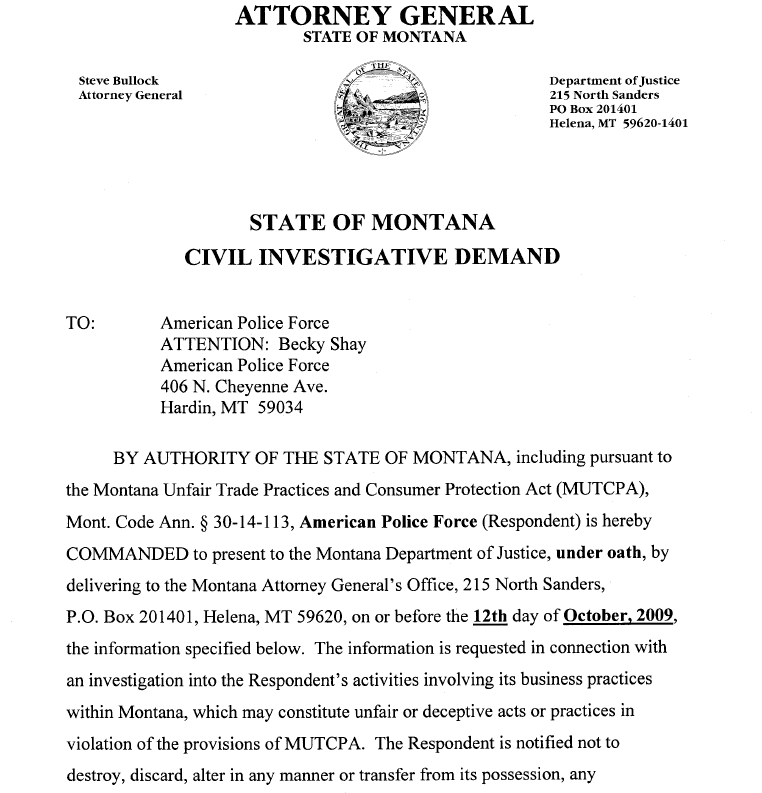
Subject: Montana Attorney General serves American Police Force in Hardin with a CIVIL INVESTIGATIVE DEMAND
Date: Monday, October 5, 2009, 1:26 PM

http://www.rumormillnews.com/cgi-bin/forum.cgi?read=157138

MONTANA Atty General takes action in Hardin

Posted By: in_PHI_nitti
Date: Saturday, 3-Oct-2009 10:33:24

CONGRATULATIONS - the State is doing its job - must be a lot of pressure.

Screen_shot_2009-10-03_at_8.26.23_AM.png

Read more…

Served time in prison for theft

APF head Hilton has history of legal trouble

Font Size:
Default font size
Larger font size

buy this photoAmerican Police Force's president Michael Hilton addresses the media during a press conference at the Two Rivers Authority jail Saturday, September 26, 2009.

  • Hardin jail press conference
  • Hardin jail press conference
  • Michael Hilton
  • Montana Jail

Related Documents

Related Links

Michael Hilton of American Police Force arrived in Hardin with promises of Mercedes police cars and expertise in operatingprisons. He delivered the cars last week, but may have learnedabout prisons following a 1993 conviction for grand theft.

Public records from police and state and federal courts in California show that Michael Anthony Hilton, using that name andmore than a dozen aliases over several years, is cited in multiplecriminal, civil and bankruptcy cases, and was sentenced in 1993 totwo years in state prison in California.

Hilton pleaded guilty in March 1993 to 14 felonies, including 10 counts of grand theft, one count of attempted grand theft and threecounts of diversion of construction funds, according to OrangeCounty court records. He was sentenced to two years in prison, butit is unclear how much time he served.

Court records in that case list his real name as Michael Hilton, but they also include the aliases Midrag Ilia Dokovitch, MidragIlia Dokovich and Michael Miodrag.

Hilton, who speaks heavily accented English, has told reporters that he is a naturalized U.S. citizen originally from Montenegro, acountry bordering Serbia, and once part of the former Republic ofYugoslavia.

The same aliases and other similar ones, all with slightly different spellings, show up in many other court documents citingHilton, including a May 2003 Orange County case in which Hiltonpleaded guilty to driving under the influence of alcohol.

A booking photo from the Huntington Beach Police Department from Hilton's DUI arrest on March 14, 2003, shows him heavier, beardlessand with more hair than he has now.

It also shows the same facial features, including a distinct arched wrinkle over his left eye, along with three deep browfurrows, small, circular indentations in the center of his foreheadand a cleft tip on the nose.

Michael Hilton and his aliases are listed as defendants in various Orange County civil cases alleging fraud and breach ofwarranty, including a March 2000 case where he is accused of fraud,larceny, breach of contract and false pretenses.

Court documents in that case allege that Hilton and others solicited investments of hundreds of thousands of dollars from theplaintiff for the creation of collectible Super Bowl commemorativecoins.

The complaint alleges that Hilton and others falsely told the plaintiff that the money would be used for the design andmanufacture of the coins, and to pay for a National Football Leaguelicense to produce them.

In fact, the complaint states, no such license was ever issued by the NFL.

Court documents show that the plaintiff obtained a 2001 judgment for $200,000 against Hilton, listing his aliases of MiodragDokovich and Midrag Ilia Dokovich.

Hilton also declared Chapter 13 bankruptcy twice during a 15-month period.

He filed under his real name, citing the alias Miodrag A. Dokovich, in November 2002, listing a Stanton, Calif., home addressand a Fountain Valley, Calif., business address tied to theBelgrade Market Liquor and Deli.

In February 2004, Hilton filed under his real name, citing the alias Miodrag Dokovich, and listing a Santa Ana, Calif., homeaddress. He estimated his assets at less than $50,000, and listedas creditors only a credit union and his landlord.

Both bankruptcy filings appear to have been intended to delay eviction proceedings against him. Under federal bankruptcy law,tenants are generally protected from eviction while they reorganizetheir finances.

Anh Q.D. Nguyen, a Garden Grove attorney, said in an e-mail that he represented Hilton's landlord in an eviction case against Hiltonthat was filed in January 2004.

Nguyen said that Hilton "filed an eleventh-hour bankruptcy petition in which my office successfully obtained relief from thebankruptcy automatic stay, in order to reclaim possession of therented premises."

Hilton had also been named as a defendant in July 2002 as part of separate eviction proceedings before his bankruptcy filing thatyear.

Hilton filed both bankruptcies without an attorney, paying less than $275 in filing fees for each. Both petitions were dismissed bythe court after Hilton failed to provide necessary documentation,including a financial reorganization plan.

Chapter 13 bankruptcies generally remain on personal credit histories for seven years, and show up on standard creditchecks.

When asked on Wednesday about Hilton's business dealings before his involvement with APF, company spokeswoman Becky Shay said,"That information is not going to be made available at thispoint."

"That's his private business. He is a man who distinguishes between private and business, between personal and corporate," shesaid.

Shay said she would check with Hilton for a comment about his DUI arrest, but did not provide further details.

She did not respond to an additional call made later Wednesday seeking more information about Hilton's other past legalproblems.

Related

Read more…
Mind Control and EM Wave Polarization Transductions - Part I, II & IIIhttp://www.cheniere.org/explore%20articles/mind%20control1/http://www.cheniere.org/explore%20articles/mind%20control1/Reprinted from "Explore" magazine, 1999http://www.cheniere.org/explore%20articles/mind%20control1/p01.htmhttp://www.cheniere.org/explore%20articles/mind%20control1/p01.htmMind Control and EM WavePolarization Transductions, Part 1©Copyright 1999 by T.E. Bearden, USASpecial NoteThis article refers to experimental research techniques which can be detrimental or lethal in the hands of any but highly skilled, qualified experimental scientists proceeding under proper laboratory safety procedures. The purpose of this article is strictly for information to properly qualified and authorized scientists in certified laboratories. We do not propose or condone any use of these procedures for nonapproved practice of medicine without a license. Neither the publisher nor the author are responsible for accidents or outcomes in the use of these experimental pro­cedures and techniques. Any researcher who performs these procedures and experiments is acting on his or her own volition, and is solely responsible for insuring safety, qualifications, and legality of the acts and their results. We neither suggest nor condone unauthorized experimentation on human subjects. Such is a criminal violation of the constitutional rights of the subject under Federal and State laws, and is both illegal and immoral.AbstractFor some time we have been repeatedly queried about the technical mechanisms and unusual electrodynamics of advanced mind control research, both in the West and abroad. Calling full attention to the special note above, in this paper we present a high-level over­view of the novel electromagnetic nature of mind operations, mindand body coupling, and intent―the induction of physical 3-space EM energy changes into the brain and nervous system, and into every cell of the body, from the mind's time-like coherent operations. We summarize the time-polarized electrodynamics used to engineer and affect mind operations and the mind-body coupling loop. Transduction mechanisms whereby differing EM wave polarizations can be transformed one-into-the-other are presented. We give two specific examples of lethal foreign military tests in 1997 of advanced mind control weapons against two military pilots over the central U.S. Some dangers and potential benefits of the emerging mind control technology are pointed outFigure 1. Mechanism that generates a mass's flow through time.EXPLORE! VOLUME 9, NUMBER 2, 1999
Read more…

Google Henry Kissinger Russian Woodpecker

Google Henry Kissinger Russian Woodpeckerhttp://www.google.com/#q=henry+kissinger+russian+woodpecker&hl=en&sa=2&fp=2cca7b2e99206b9cGoogle henry Kissenger Allied Chemicalhttp://www.google.com/#hl=en&q=henry+kissinger+%22allied+chemical%22&aq=f&aqi=&aq=&aqi=&aq=f&aqi=&oq=&fp=2cca7b2e99206b9cWe can bomb the bejesus out of them all over North Vietnam."

Archive Publishes Treasure Trove of Kissinger Telephone Conversations

Comprehensive Collection of Kissinger "Telcons" Provides Inside View of Government Decision-Making;
Reveals Candid talks with Presidents, Foreign Leaders, Journalists, and Power-brokers
during Nixon-Ford Years

National Security Archive Electronic Briefing Book No. 263

Edited by William Burr

Posted - December 23, 2008

See also - "Dr. Kissinger, Mr. President"
Kissinger's Telcons and Nixon's Tapes

join.jpg

Links

Kissinger Telephone Conversations: A Verbatim Record of U.S. Diplomacy, 1969-1977

Digital National Security Archive (ProQuest)

Related postings

"Dr. Kissinger, Mr. President"
Kissinger's Telcons and Nixon's Tapes

The Kissinger State Department Telcons
Telcons Show Kissinger Opposed Human Rights Diplomacy;
Secretary of State Tapped Own Phone Calls

The Kissinger Telcons
Archive CelebratesRelease of Previously Sequestered Telephone Records

Washington, D.C., December 23, 2008 - Amidst a massive bombing campaign over North Vietnam, Henry Kissinger and Richard Nixon candidly shared their evident satisfaction at the “shock treatment” of American B 52s, according to a declassified transcript of their telephone conversation published for the first time today by the National Security Archive. “They dropped a million pounds of bombs,” Kissinger briefed Nixon. “A million pounds of bombs,” Nixon exclaimed. “Goddamn, that must have been a good strike.” The conversation, secretly recorded by both Kissinger and Nixon without the other’s knowledge, reveals that the President and his national security advisor shared a belief in 1972 that the war could still be won. “That shock treatment [is] cracking them,” Nixon declared. “I tell you the thing to do is pour it in there every place we can…just bomb the hell out of them.” Kissinger optimistically predicted that, if the South Vietnamese government didn’t collapse, the U.S. would eventually prevail: “I mean if as a country we keep our nerves, we are going to make it.”

The transcript of the April 15, 1972, phone conversation is one of over 15,500 documents in a unique, comprehensively-indexed set of the telephone conversations (telcons) of Henry A. Kissinger—perhaps the most famous and controversial U.S. official of the second half of the 20th century. Unbeknownst to the rest of the U.S. government, Kissinger secretly taped his incoming and outgoing phone conversations and had his secretary transcribe them. After destroying the tapes, Kissinger took the transcripts with him when he left office in January 1977, claiming they were “private papers.” In 2001, the National Security Archive initiated legal proceedings to force the government to recover the telcons, and used the freedom of information act to obtain the declassification of most of them. After a three year project to catalogue and index the transcripts, which total over 30,000 pages, this on-line collection was published by the Digital National Security Archive (ProQuest) this week.

Kissinger never intended these papers to be made public, according to William Burr, senior analyst at the National Security Archive, who edited the collection, Kissinger Telephone Conversations: A Verbatim Record of U.S. Diplomacy, 1969-1977. “Kissinger’s conversations with the most influential personalities of the world rank right up there with the Nixon tapes as the most candid, revealing and valuable trove of records on the exercise of executive power in Washington,” Burr stated. For reporters, scholars, and students, Burr noted, “Kissinger created a gift to history that will be a tremendous primary source for generations to come.” He called on the State Department to declassify over 800 additional telcons that it continues to withhold on the grounds of executive privilege.

The documents shed light on every aspect of Nixon-Ford diplomacy, including U.S.-Soviet détente, the wars in Southeast Asia, the 1969 Biafra crisis, the 1971 South Asian crisis, the October 1973 Middle East War, and the 1974 Cyprus Crisis, among many other developments. Kissinger’s dozens of interlocutors include political and policy figures, such as Presidents Nixon and Ford, Secretary of State William Rogers, Governor Nelson Rockefeller, Robert S. McNamara, and Soviet Ambassador Anatoli Dobrynin; journalists and publishers, such as Ted Koppel, James Reston, and Katherine Graham; and such show business friends as Frank Sinatra. Besides the telcons, the Kissinger Telephone Conversations: A Verbatim Record of U.S. Diplomacy, 1969-1977 includes audio tape of Kissinger’s telephone conversations with Richard Nixon that were recorded automatically by the secret White House taping system, some of which Kissinger’s aides were unable to transcribe.

A series of unforgettable moments are captured in the transcripts, not least involving Kissinger’s complex and difficult relationship with Richard Nixon. Repeatedly, the national security adviser used his skills in flattery and connivance to help build up the president’s image and stay in his good graces. During the Jordan crisis in September 1970, Kissinger told the media that he had awakened the President to brief him on King Hussein’s military actions against Palestinian guerillas. But a transcript of his call to the President the next day recorded him as informing Nixon: “in light of the fact that there was nothing you could do, we thought it best not to waken you.”

The telcons also illustrate other Kissinger’s efforts to spin the media, monitor and control the process of decision-making, disparage rivals, keep important associates, such as his patron Nelson Rockefeller, in the loop, and win over critics:

  • After Gerald Ford shuffled his cabinet in November 1975, removing Kissinger as national security adviser and shifting Donald Rumsfeld from his chief-of-staff position to be Secretary of Defense, Kissinger spoke to Secretary of the Treasury William Simon. “The guy who cut me up inside this building isn’t going to cut me up any less in Defense,” he noted.
  • In an August 13, 1974, conversation with Elliott Richardson after Nixon resigned, Kissinger disparaged George H.W. Bush as a candidate to replace Gerald Ford as Vice President. “I am not as high on George Bush, as some others are, partly because of his lack of experience.”
  • In a conversation with President Nixon on the illegal wiretap scandal in June 1973, Nixon threatened to go to political war with Democrats if they pressed the issue. “Lets get away from the bullshit,” Nixon stated angrily. “Bobby Kennedy was the greatest tapper.” The President even suspected his own phone had been wiretapped in the early 1960s. “[J.Edgar Hoover] said Bobby Kennedy had [the FBI] tapping everybody. I think that even I’m on that list,” President Nixon told Kissinger. When Nixon noted that the wiretap scandal would “catch some of your friends,” Kissinger responded: “Well, I wouldn’t be a bit unhappy.”
  • In a bizarre conversation with anti-war activist/poet Alan Ginsburg on April 23, 1971, Kissinger discussed meeting with ardent opponents of the Nixon administration. Ginsburg suggested the meeting, joking that “It would be even more useful if we could do it naked on television. “I gather you don’t know how to get out of the war,” Ginsburg is recorded as stating. “I thought we did,” Kissinger responded, “but we are always interested in hearing other views.”

In the April 15, 1972, conversation about bombing North Vietnam, Nixon recalled that bombing had failed to defeat Ho Chi Mhin’s forces in the past.

Nixon: “Of course, you want to remember that Johnson bombed them for years and it didn’t do any good.”

Kissinger: But Mr. President, Johnson never had a strategy; he was sort of picking away at them. He would go in with 50 planes; 20 planes; I bet you we will have had more planes over there in one day than Johnson had in a month.

Nixon: Really?

Kissinger: Yeah.


The Kissinger Telephone Conversation Transcripts

Today the National Security Archive announces the publication of a comprehensively unique, thoroughly-indexed set of the telephone conversation (telcon) transcripts of Henry A. Kissinger, one of the most famous and controversial U.S. diplomats of the second half of the 20th century. Consisting of 15,502 documents and over 30,000 pages, this on-line collection, published by the Digital National Security Archive (ProQuest), is the result of a protracted effort by the National Security Archive to secure this critically important record of U.S. diplomacy during the administrations of Richard M. Nixon and Gerald R. Ford, when Kissinger served as National Security Adviser and Secretary of State. Collectively, the documents include the telcons released at the Nixon Presidential Library as well as those declassified by the State Department as a result of the Archive’s Freedom of Information Act request. The set sheds light on every aspect of Nixon-Ford diplomacy, including U.S.-Soviet détente, the wars in Southeast Asia, the 1971 South Asia crisis, and the October 1973 Middle East War, among many other developments. Kissinger’s many interlocutors include political and policy figures, such as Presidents Nixon and Ford, Secretary of State William Rogers, Governor Nelson Rockefeller, former Secretary of Defense Robert S. McNamara, and Soviet Ambassador Anatoli Dobrynin; journalists and publishers, such as Ted Koppel, James Reston, and Katherine Graham; and such show business friends as Frank Sinatra.

Besides the paper records of Kissinger’s telcons, the Archive’s publication includes unique audio material from the Nixon White House tapes. Apparently the tapes used by Kissinger’s staff to prepare the telcons no longer exist. While Nixon and White House staffers eventually learned that this was Kissinger’s practice, no one except Nixon and a few aides realized until the summer of 1973 that Nixon was secretly taping his phone conversations as well as meetings with Kissinger and other officials. Thus, audio and paper records exist for some of the same conversations. Moreover, some of Nixon’s White House tapes are the only source for some Nixon-Kissinger telephone conversations. As a special feature in this collection, the Archive includes as many of the audios of Nixon-Kissinger telephone conversations as possible.

That these documents are available in the first place is the result of the protracted efforts of the National Security Archive. Once Henry Kissinger left the State Department in early 1977, he transferred the telcons and other material to the Library of Congress as “private papers.” Soon journalists had tried to force the release of the telcons through a Freedom of Information Act lawsuit, but the Supreme Court ruled that they had no standing to sue. There the matter lay until 1999 when the National Security Archive wrote to the State Department and the National Archives and Records Administration (NARA) questioning whether Kissinger had the right to keep these documents, which were public records produced by White House and State Department staffers. The National Security Archive had the option of filing a law suit to ensure that these agencies observed federal records laws, but neither the State Department nor NARA were interested in litigation; instead, they asked Kissinger to return the records. He complied by returning sets of copies to those agencies in 2002. Two years later, the Nixon Presidential Materials Project (now the Nixon Presidential Library and Museum) opened for research the telcons covering the January 1969-August 8, 1974 period. The State Department kept a slightly overlapping set covering the period September 1973 through December 1976, when Kissinger was Secretary of State.

While most of the telcons from the Nixon years were available at the National Archives, significant numbers were still classified and the National Security Archive has begun filing mandatory review requests for them. For the telcons held by the State Department, it took a Freedom of Information Act request, filed in by the National Security Archive in 2001, to begin opening them up. From 2002 to 2008, the Department declassified or released in excised form over 6,000 telcons. A number of telcons were denied, in whole or in part, on privacy or national security grounds; while some were released under appeal, some material remains unavailable. Moreover, in a June 2007 decision, the State Department withheld over 800 telcons, many of them conversations with the late Gerald R. Ford. Those telcons are under appeal.

The State Department’s decision to withhold over 800 telcons is extraordinary. The Department’s decision letter invoked the (b) (5) exemption of the Freedom of Information Act, which federal agencies interpret to permit the exemption of “inter-agency or intra-agency communications containing deliberative process, attorney-client, attorney work product information or privileged presidential communications.” That the Department used (b) (5) exemption and the claim of “privileged presidential communications” to exempt thirty year old documents may make this one of the biggest abuses of (b) (5) and privilege claims the history of the FOIA. As federal courts have ruled, such privileges erode over time, and as time passes the public interest in open historical records has far greater weight. In the soon-to-depart Bush administration, such considerations have little influence and it is no surprise that the hands of the White House are behind the executive privilege claims. Henry Kissinger has been an adviser to President Bush and Vice President Cheney and, according to government sources, he influenced the declassification review process to ensure that his telephone discussions with President Ford remain classified for as long as possible.

A. Selected Telcons with Audio Versions from Nixon’s White House Tapes

Document 1: “How Do I know You are Not Stealing Papers All over the Place”
With President Nixon, June 17, 1971, 7:40 P.M. (Conversation 005-117 - MP3)
The ongoing publication by The New York Times and the imminent publication by The Washington Post of the “Pentagon Papers” (officially titled, United States–Vietnam Relations, 1945–1967: A Study Prepared by the Department of Defense), leaked by RAND Corporation staffers Daniel Ellsberg and Anthony Russo, created a crisis in the Nixon administration. As this telcon suggest, Nixon wanted to deflect any controversy over the war to his predecessors by getting former President Johnson and his national security adviser Walt Rostow to make statements about the leak. The typed telcon conveys the thrust of the conversation, but one hearing of the very clear White House audiotape shows that Kissinger’s aides missed quite a few details. Like many, this telcon is not close to verbatim. For example, on page 2 of the document it is evident that the transcriber did not hear that Kissinger said, to the effect that “These people are undermining confidence in government. You [Nixon] are resisting the flouting of law and the idea that the end justifies the means.” Moreover, Kissinger recounts his conversation with Time magazine correspondent Jerrold Schechter, who, allegedly said, “how do I know you are not doing the same thing?” with respect to Vietnam. Kissinger told Nixon that he replied: “how do I know you are not stealing documents all over the place.” Worried about the impact of the publication of the top secret study of Vietnam War decision-making, Nixon wanted legal action against those newspapers but the Supreme Court rejected the Justice Department request for an injunction against the Times and the Post.

Document 2: “We Can Bomb the Bejesus Out of Them”
With President Nixon, 15 April 1972, 11:30 P.M. (Conversation 022-131)
In the weeks after North Vietnam’s 1972 Spring Offensive, Nixon and Kissinger ordered heavier bombing of the North, although withholding attacks on Hanoi or mining Haiphong Harbor, two actions which they held out for the next decision to escalate. This conversation, which took place when Kissinger was at home, was fully recorded on the White House tape system, but apparently Kissinger’s tape player did not begin recording it for transcription purposes until about 10 and a half minutes into the conversation. The Nixon tape, which is at a low volume and not easy to follow, begins with a discussion of diplomatic strategy, including Kissinger’s talks with Soviet Ambassador Dobrynin that day (which are reported in detail in the State Department historical volume, Soviet-American Relations: The Détente Years). (Note 1) In light of Hanoi’s decision to postpone private talks with Kissinger scheduled for 24 April), Kissinger told Dobrynin that “such behavior by Hanoi [was] clear evidence of an unwillingness to conduct serious negotiation and as reflecting a basic desire of the North Vietnamese ‘to bring down a second American president.’” While the White House was willing to hold back on attacks on Hanoi or Haiphong, Nixon believed that such threats were a “hold card” in the negotiations: “It either got to be [a] settlement or we blockade.” Besides discussing details of military strategy, which is accurately recorded in the telcon (at least the discussion in the second half of the conversation), they discussed the schedule of Kissinger’s forthcoming secret trip to Moscow, which was to occur in a few days.

Document 3: “The Fellow Has got to be Out of His Mind After the Letter That I Wrote”
With President Nixon, 18 November 1972, 12:18 P.M. (Conversation 033-092 - MP3)
With the Vietnam War peace negotiations in their end-game, the Nixon administration was baffled by problems with its South Vietnamese ally, President Nguyen Van Thieu. As listening to the audio confirms, this telcon is a highly accurate rendition of the conversation. Furious with the draft peace agreement that Kissinger had negotiated with North Vietnamese diplomat Le Duc Tho, Thieu and his advisers kept suggesting changes to favor Saigon’s position. Having already written Thieu to the effect that the “bargaining [was] over,” Nixon suggested that Thieu “has got to be out of his mind” to keep pushing for changes. Nixon insisted that “we will not be subjected to harassment” and rejected the idea of a South Vietnamese emissary coming to Washington; as it turned out, however, the harassment continued and South Vietnamese diplomats were in the Oval Office within a few weeks. The most difficult point, and one on which Nixon and Kissinger refused to give ground, was Thieu’s insistence that North Vietnamese forces leave the South at the same that U.S. forces exited South Vietnam. As Nixon observed during this conversation, “withdrawal has to be handled on the basis that we already suggested.” That the North would keep its forces in pockets of South Vietnam was a condition for the January 1973 Paris Peace Agreement, but one which could only raise doubts about the Saigon regime’s future. Listening to the audio confirms that this telcon is a highly accurate rendition of the conversation.

B. Selected Telcons
I. The White House Years: As National Security Adviser

Document 1: “You Can’t Write History After You’ve Seen a Thing Like That”
With Under Secretary of State for Political Affairs, U. Alexis Johnson, 19 January 1970 10:40 a.m.
One of the most complex negotiations during the first year of the Nixon negotiations involved a textiles agreement that was linked to the U.S. reversion of Okinawa to Japan. Under pressure from southern states to protect the textile industry from Japanese competition, Nixon and Kissinger found it difficult to get Tokyo to follow through on an understanding that they believed had been reached with Japanese Prime Minister Sato during his November 1969 visit. While they thought that Sato had agreed to a “comprehensive” solution to be reached by the end of December, the Prime Minister did not have the same understanding. This telcon with Undersecretary of State for Political Affairs U. Alexis Johnson (himself a former ambassador to Japan) conveys some of the confusion caused by the fact that key Japanese officials as well as U.S. ambassador Armin Meyer did not know about the secret Nixon-Sato understanding (“piece of paper”). At the end of the conversation, Kissinger observed that “you can’t write history after you’ve seen a thing like that. Documents have nothing to do with it.”

Document 2: “Some of the Stories Are Awful … I Don’t Think the Public Likes It”
With President Nixon, 17 March 1970 8:07 p.m.
The collection of Kissinger telcons at the Nixon Library is comprehensive, but not complete. A number of telcons have surfaced in other collections, not only elsewhere in the Nixon Papers but in State Department collections as well. This is an example of a telcon that is not in the Kissinger telcon collection but was found in a file on “Israeli Aid” that shows up in the National Security Council files. During this conversation, after a brief discussion of U.S. military aid to Israel (assurances of up to 8 Phantoms and 20 Skyhawk jets), and before turning to the bombing of Laos, Nixon and Kissinger discuss the My Lai investigation led by Army General William Peers. Although Nixon insisted that the cover-up “was in the interests of the country,” Kissinger was less confident that this was so and more disturbed by the brutality of the incident: “some of the stories are awful.” Nixon, however, had no doubt: “We know why it was done. These boys were being killed by women carrying that stuff in their satchels.”

Document 3: “Knock the Bejesus Out of Them”
With President Nixon, 17 September 1970, 9:00 a.m., Excised copy
Excised copy
This telcon of Nixon-Kissinger discussion during the September 1970 Jordanian crisis was declassified as a result of the Archive’s mandatory review request. (Note 2) On the morning of 17 September, Nixon was in Chicago for mid-term electioneering and Kissinger called him to report that Hussein had initiated military actions against the fedayeen. The New York Times later reported that Kissinger and Haldeman had woken Nixon up in the middle of the night to tell him the news, but as Kissinger acknowledged to Nixon, they made that up, apparently to dramatize Nixon’s role. (Note 3) When Kissinger described Hussein’s actions as a “crisis,” Nixon said “a crisis that’s good,” no doubt because he found it useful politically. Mentioning that Hussein had already consulted with the United States before his move, Nixon queried whether the “move is a result of our encouraging him.” Kissinger did not give an unequivocal answer, but said that Washington had been trying to “stiffen his back.” Both turned to the problem and possibility of Syrian and Iraqi intervention (Nixon mistakenly referred to “Iranians”) to support the fedayeen. If that happened, Nixon wanted to “use American air and knock the bejesus out of them.” While Kissinger agreed, he observed there “are strong arguments on both sides.” Moreover, he pointed to an intelligence problem; U.S. intelligence was trying to “acquire the targets,” but “we’ve got to know where to hit.” While Nixon thought that a “landing team” might be necessary to evacuate U.S. nationals, it would be “another thing” if the Marines started fighting because of the risk of Soviet intervention.

Document 4: “If You See Helms, Ask Him if he has Begun Meditating Yet.”
With Allen Ginsberg, 23 April 1971 7:50 p.m.
Not long before the “May Day” anti-war demonstrations in Washington, poet Allen Ginsberg called up Kissinger to arrange a meeting with Rennie Davis (one of the “May Day Tribe” leaders), David Dellinger, and Ralph Abernathy. While Kissinger appeared to be willing to go along with the idea of a private meeting, Ginsberg joked about having a discussion “naked on television.” In any event, once it was clear that Ginsberg wanted a meeting at the beginning of the May Day demonstrations, Kissinger was not sure that he would be in town. Kissinger ended the conversation by agreeing to call Senator Eugene McCarthy, who, according to Ginsberg, had suggested the call.

Document 5: “We Have to Be a Little Unprincipled Ourselves”
With White House Counsel Charles Colson, 13 July 1972 9:22 a.m.
This document illustrates the role of Nixon “hatchet man” and White House counsel Chuck Colson, later indicted for the Watergate burglary cover-up, during the 1972 campaign. After a brief discussion of the efforts of some Teamsters officials to get a pardon for former president Jimmy Hoffa, so he could go to Hanoi and negotiate the release of POWs there, Colson discussed his efforts to get support for the Nixon campaign from the Teamster’s union, and its president, Frank Fitzsimmons. To win support from local and union officials for a Nixon endorsement, apparently Fitzsimmons used intimidation tactics, such as threats of “early retirement” against vice president Harold Gibbons, who had been on Nixon’s enemies list for his role as a founder of Labor for Peace. When discussing the McGovern campaign organizations, Colson and Kissinger observed that they’re “shrewd” and “unprincipled,” which led Colson to conclude that “That just means we have to be a little unprincipled ourselves.”

Document 6: “There is No Stunt Involved”
With John Kenneth Galbraith, 22 August 1972 12:10 p.m
Another conversation (and an incomplete one at that) that did not appear in the main Kissinger telcon collection, this one with Harvard economics professor “Ken” (“Stan” was a stenographer’s error) Galbraith also took place during the 1972 campaign. After some friendly chatter, Kissinger turned to political attacks on him from the Democratic campaign. While noting that the attacks actually helped his position in the White House, he argued that his talks with Hanoi to end the war were not a “stunt,” even if it “will help the president if it succeeds,” but was a “serious negotiation.” After the election, Kissinger wanted to do his “damndest to leave the bridges open to the liberal community as I have done before and it’s not going to help me very much if I become the chief [villain]. … I [,] the guy who has been the only one who has had intellectuals and liberals in here.” While the record of the rest of the conversation appears not to have survived, perhaps Kissinger was suggesting that the “bridges” might not stay open if the liberals kept attacking him. In any event, Kissinger came to be regarded as a “villain” for decisions and actions (e.g., the “Christmas bombing,” East Timor and Chile) that he may have found justifiable, but that others found objectionable.

Document 7: “Now the Biggest [Wire] Tapper Was Bobby Kennedy”
With President Nixon, 1 June 1973 7:00 p.m.
With the Watergate Crisis unfolding, Nixon’s position was precarious; the Senate Watergate Committee was starting to hold its hearings, although it would be some weeks before the discovery of the White House tapes. But Watergate was not the only scandal afflicting the White House; days earlier, it was reported that in 1969 the Nixon White House had authorized the FBI to wiretap a number of NSC and Defense Department officials who were suspected of leaking information to The New York Times. Kissinger was closely associated with the decision (and later issued an apology for the wiretaps as a condition for settling Morton Halperin’s lawsuit against him). Outraged by former National Security Adviser McGeorge Bundy’s apparent claim that Attorney General Robert Kennedy did not use wiretaps, Nixon argued that wiretapping in the Kennedy administration dwarfed anything done in his administration (240 compared to 110). Moreover, to confound Kissinger’s “liberal friends,” Nixon wanted the numbers put out immediately (evidently this was not done). During a brief discussion of coverage of the meeting with French president Pompidou held in Iceland, the day before, Nixon angrily denounced press coverage of the administration.

II. As Secretary of State and National Security Adviser

Document 8: “We Are Going to … Def Con Three Alert”
With British Ambassador Lord Cromer, 25 October 1973, 1:03 a.m.
One of the moments of crisis during the October 1973 Arab-Israeli War was after Israeli forces crossed the west bank of the Suez Canal and encircled the Egyptian Third Army. Moscow’s concern for the fate of its Egyptian client led General Secretary Leonid Brezhnev, on 24 October, to send a letter to President Nixon raising the possibility of Soviet unilateral action to support Egypt. (Note 4) In light of Brezhnev’s letter, and the perception of threat, Kissinger and the National Security Council had a late night meeting where they agreed to put U.S. military forces world-wide on a higher state of alert, Defcon 3, but not so high as to raise concern in Moscow about U.S. military action. Nixon was not directly involved in the NSC meeting as he was distressed over Watergate developments as well as Vice President Agnew’s recent resignation (over corruption charges). Soon after making the meeting, Kissinger phoned up British ambassador Cromer to inform him of the alert and the considerations that led to it. That the British and European NATO allies were skeptical of the alert and questioned the lack of consultation before Washington made the decision contributed to tensions in U.S-European relations during the final months of 1973.

Document 9: “So – you don’t like those paintings?”
With White House Special Counsel Leonard Garment, 27 December 1973, 10:59, p.m.
Kissinger had been Secretary of State for only a month when the October War broke out in the Middle East. From then on, Kissinger was intensely involved in negotiations to reduce tensions in the region. On 27 December 1973, Kissinger had met with a group of Jewish community leaders to discuss the Middle East crisis and the ongoing negotiations. One of the attendees was White House special counsel Garment, who played an important liaison role in the Nixon White House. Garment made critical comments on the abstract painting that he had seen in Kissinger’s office and suggested that he replace it with some nice Bonnards and impressionist pieces. Garment argued that Kissinger was “a classical man with a classical style” and that abstraction was “symptomatic of the decline and fall of everything.” Although Kissinger was known to worry about the decline of American power, Garment’s claim about the art did not bother him; “I happen to like it.”

Document 10: Diego Garcia
With Deputy Secretary of Defense Kenneth Rush, 24 January 1974, 9:28 a.m.
During the early 1970s, London and Washington negotiated the turnover to the latter of Diego Garcia, the largest of the Chagos Islands archipelago in the Indian Ocean. The controversial move involved the dispossession of the archipelago’s 1700 inhabitants, but the United States sought Diego Garcia for military operations in the region, initially for naval communications (e.g., with submarines operating in the Indian Ocean). During the 1990s and earlier this century it also became an air base for operations in Afghanistan and Iraq. Allegations have also been made that the island has become integral to the ferrying of detainees captured in Afghanistan and elsewhere. This was all in the future, but in the 1974 negotiations, Washington wanted “uninhibited” use of the island, while the British wanted to retain some appearance of control. Kissinger and Rush agreed that the United States would have to agree to “innocuous” language about consultation.

Document 11: Massacre in Israel
With British Foreign Secretary James Callaghan, 13 April 1974, 4:10 p.m., Excised copy
Kissinger developed a close working relationship with James Callaghan, who had become Foreign Secretary when the Labor Party formed a government a month earlier. The present release includes a number of telcons with Callaghan and Ambassador Peter Rambsbottham on Cyprus and Greece, among other issues. Communication problems bedevil this conversation leading Callaghan to propose that U.S. and British officials listening in on the conversation put down their receiver in order to strengthen the trans-Atlantic signal. At this suggestion, Kissinger laughed--because he was going to do no such thing. A good part of the discussion was on coordinating positions on recent developments in Israel: Palestinian guerrillas had attacked Israeli civilians, near the border with Lebanon, to which the Israelis responded with a raid in several Lebanese villages.

Document 12: “I Can Always Count on You Being Filthy”
With Foreign Secretary Callaghan, 22 July 1974, 11:25 a.m.
Kissinger and Callaghan continued to have problems with trans-Atlantic calls but US-UK communications increased during the unfolding Cyprus crisis. Wanting to avoid antagonizing the Greek junta which had sponsored the 18 July 1974 coup against Archbishop Makarios, Kissinger opposed putting any pressure on them. As he had explained to his State Department “Cyprus group”, “To attempt to overthrow the Greek Government to satisfy our souls and bring Makarios back is a high price to pay.” (Note 5) Turkey invaded Cyprus on 20 July and two days later, the day the Greek military dictatorship fell, on 22 July, Callaghan and Kissinger discussed developments. Both agreed that Nicos Sampson, the gunman whom the Greek junta had installed to rule the island, had to go, because of his role in provoking the Turkish invasion, but the junta’s collapse quickly put Sampson out of power. Thus, the banter about Kissinger being “filthy” to Sampson was irrelevant. Plainly Callaghan and Kissinger had different takes on the situation, with Callaghan stating that Archbishop Makarios, the deposed President, was the “legitimate President,” while Kissinger took a “noncommittal” stance. Kissinger wanted freedom of action on the Cyprus problem and did not want to support Makarios, whom he had seen as too independent. While the conversation was affable, Kissinger later declared that “Basically Callaghan screwed up all along” by not pressing the Greeks to be a more forthcoming toward Turkey. (Note 6)

Document 13: “Inordinately Painful”
With Federal Reserve Board Chairman Arthur Burns, 10 August 1974, 2:33 p.m.
Kissinger and Burns commiserated over Nixon’s resignation and the circumstances surrounding it. According to Kissinger, Nixon’s family was not helpful because “they wanted to keep fighting” but he believed that the fight could not go on: “Enough is enough.” Plainly a supporter of some kind of pardon, Kissinger did not want “to see a former President … in jail or in court. He wasn’t a bad president.”

Document 14: Lobbying for the Vice Presidency
With Former Secretary of Defense Elliot Richardson, 13 August 1974
Once Gerald Ford became president, there was no Vice President and the new President would have to make a decision. With his wealth of government experience—at the Justice Department, State Department, Pentagon, and Department of Health Education and Welfare—Elliot Richardson took it for granted that he was well qualified to serve. Nelson Rockefeller, Kissinger’s former patron was in the lead, but if it did not work out, Kissinger assured Richardson that he would personally prefer him; he “wouldn’t have anybody else.” Certainly, Kissinger respected Richardson and had worked well with him in his previous roles. Kissinger made it plain that he could not support George Bush “partly because his lack of experience.”

Document 15: “I Am Afraid it is a Little Late”
With Greek Prime Minister Constantine Karamanlis, 15 August 1974, 7:22 P.m.
Not having to protect the Greek junta, Kissinger became more worried about pressure on Turkey, a major NATO ally; thus, he “slightly tilted” U.S. policy toward Turkey. As Geneva negotiations on Cyprus began to collapse on 13 August, the U.S. took the position that Turkish claims for greater influence on Cyprus were just, even if it would be wrong for Ankara to use force to uphold them. The next morning, Turkey launched the second phase of their invasion, which brought them control over 37 percent of the island but also led to a significant refugee problem, as over 180,000 Greek Cypriots fled south. The next day, Kissinger phoned Prime Minister Karamlanlis, the leader of the new civilian government, to inform him that Ankara would stop military operations the next day and “we will hold them to this promise.” Karamlanlis lacked the military forces to go to war with Turkey, which was his preference, and it was evident that Washington was not going to try to reverse the Turkish encroachments. The Prime Minister saw Kissinger’s words of “friendship for Greece” as a “little late”, arguing that “you [Kissinger] have to do something more than give advice to the Turks.” Kissinger, however, had little sympathy for the Greek leadership because he believed that they had failed to make the compromises that he believed necessary to appease the Turks.

Document 16: Seymour Hersh’s Revelations
With White House Chief of Staff Donald Rumsfeld, 23 December 1974, 9:35 a.m., Excised
The morning that Seymour Hersh’s story on spying on Americans appeared in The New York Times, Kissinger spoke with White House chief of staff Donald Rumsfeld. Kissinger said he knew nothing about the events discussed in the Hersh story reported but wanted Colby to prepare a report for the President. “Obviously the CIA must operate in the law.” The heavy excisions in this telcon are a good example of the abuse of the (b) (5) “predecisional” exemption in this FOIA case.

Document 17: “The Damage These Bastards Have Done”
With NSC Staffer William Hyland, 22 February 1975, 3:30 p.m.
Action taken by Congress, with Senator Henry Jackson (D-Wa) in the forefront, penalizing the Soviet Union for its policies on Jewish émigrés from the Soviet Union had a serious impact on the détente that Kissinger had helped forge. Kissinger and Hyland, a former CIA expert on Soviet policy, agreed that the “Jackson crowd” had done “unbelievable,” even “irreparable” damage to U.S. relations with Moscow.

Document 18: “It would be a disaster … if they took on the President”
With Max Fisher, 24 March 1975, 7:10 [p.m.]
A breakdown in negotiations over the second phase of Israeli disengagement from the Sinai—Prime Minister Rabin had rejected President Sadat’s offer--led Ford and Kissinger to threaten a re-evaluation of U.S. policy. A phone conversation between Kissinger and Max Fisher, a Republican supporter active in Jewish causes, captured the state of tension as controversy over Sinai II unfolded. The next day, speaking with President Ford, Kissinger said that “Fisher called me in a state of agitation.” Believing that the Israelis were being uncooperative and worried that the U.S. Jewish community would attack the administration’s step-by-step diplomacy, Kissinger advised Ford that “We have to show Israel that we are a great power and they don’t run our foreign policy.”

Document 19: “A casualty of Watergate”
With New York Times columnist James Reston, 16 April 1975, 4:30 p.m.
With North Vietnamese forces threatening to bring down the U.S.-supported Saigon regime, Kissinger was constantly on the phone to discuss the situation. Talking with New York Times columnist James Reston, Kissinger argued that Washington would have been in a better position to support Saigon, and enforce the peace agreement with Hanoi, if Watergate had not toppled Nixon: “I think the agreement could have held without Watergate [which] so weakened the executive authority.” Counter-factual history is always problematic but, even without Watergate, it can be argued that Congress was so determined to get the United States out of any fighting role in Southeast Asia, that it is unlikely that it would have permitted any White House bombing operations to enforce the peace treaty.

Document 20: Contacts with Iraq, North Korea, and the Soviet Union
With Chase Manhattan Bank Chairman David Rockefeller, 19 April 1975, 6:12 p.m.
Throughout the Nixon and Ford administration, Chase Manhattan Bank Chairman David Rockefeller was in routine contact with Kissinger; Rockefeller had been an important Nixon supporter. Chase Manhattan was an influential bank, and Rockefeller’s brother, Nelson, had been Kissinger’s patron since the late 1950s. With the world becoming awash in petro-dollars, major U.S. banks were expanding their contacts with countries in the Middle East, and Iraq was one of them. Although Baghdad had broken relations with Washington during the 1967 Six Day War, Kissinger was interested in developing a relationship, especially because Iran and Iraq had resolved some of their tensions. Thus, if one of Chase’s envoys met with Saddam Hussein, he wanted them to let him know that Washington “would be prepared to have political contacts with them.” Besides Iraq, Rockefeller and Kissinger discussed Chase’s approaches to North Korea, the oil producers-consumers conference, the State Department’s contact for Bilderberg conference matters, Rockefeller’s forthcoming visit to Turkey, developments in the Middle East negotiations, and Rockefeller’s recent talk with the Soviet economist Stanislav Men’shikov (whose father had been ambassador to the United States during the 1950s) about Soviet détente policies.

Document 21: “We Will Not Stand Still for the Radicalization of the Arab World by Your Actions”
With Israeli Ambassador Simcha Dinitz, 22 July 1975, 10:50 a.m.
The threatened reevaluation of U.S. Middle East policy only produced a return to step-by-step diplomacy after it became evident that Congress would not permit any pressure on the Israelis; moreover, Presidents Ford and Sadat had productive meetings suggesting that the talks on Sinai could get back on track. Nevertheless, tensions between Israel and the United States persisted as was evident in Kissinger’s conversation with Ambassador Dinitz. First, Kissinger took offense at the way Israeli handled a proposal to establish U.S.-staffed warning stations on the Sinai. Second, he found “totally unacceptable” Israeli pressure against U.S. military aid to Jordan. As difficult as Sinai II was to negotiate, by the end of August, the three sides had signed an agreement.

Document 22: “I Don’t Want a Drooping Irishman Around Here”
With Ambassador to the United Nations Daniel Pat Moynihan, 6 August 1975
This long conversation with Ambassador to the United Nations Daniel P. Moynihan (former Nixon White House staffer and U.S. Ambassador to India, future Senator from New York) focused on the issue of admission to the United Nations of North Vietnam and South Vietnam, the difficulties of getting a clear message on Kissinger’s position, and instructions for U.S. action in the General Assembly and Security Council. Recognizing that it was impossible to deny UN membership to the two Vietnams for any length of time, Kissinger wanted to delay admission as a bargaining chip. In the short-term, it was not “right” to admit South Vietnam into the UN the same year that “we got run out of Indochina,” and it would be a “disaster to [President Ford] with the right.” Four days later, at the UN Security Council Moynihan blocked the admission of the two Vietnams into the United Nations, arguing that if the Council had even considered a proposal for the admission of South Korea he would have acted otherwise.

Document 23: “What a Disaster”
With Deputy National Security Adviser General Brent Scowcroft, 16 October 1975, Excised copy
During a dinner in Ottawa, Kissinger spoke frankly about former presidents, including Kennedy and Nixon, but he did not realize that the microphone was on and that the press had listened to the entire conversation. Soon Kissinger’s remarks, e.g., that Nixon was a “difficult and unpleasant man,” were a major media story. During this conversation with his deputy Brent Scowcroft, who was sympathetic and horrified, Kissinger said he wasn’t sure what to do, but finally decided that he should “call [Nixon] and tell him.” Scowcroft agreed, noting that it would be “worse” if Kissinger did not. They also discussed a New York Times story by Leslie Gelb about the deadlocked SALT II talks; both agreed that it was based on leaks from Pentagon officials who wanted to undermine Kissinger’s assertion that the negotiations were “95 percent” complete.” Indeed, the SALT II agreement was not complete until 1979, when Moscow and Washington signed it.

III. After the “Halloween Massacre”: Secretary of State Only

Documents 24A and B: “The Guy That Cut Me up Inside this Building Isn’t Going to Cut Me Up Any Less in Defense”
A. With New York Times columnist James Reston, 3 November 1975
B. With Treasury Secretary William Simon, 3 November 1975
A few days earlier, Kissinger learned that President Ford had shaken up his cabinet: Kissinger was fired as national security adviser, replaced by his deputy Brent Scowcroft; James Schlesinger was fired as Secretary of Defense, replaced by White House Chief of Staff Donald Rumsfeld, and William Colby was to leave the CIA, with George H.W. Bush taking his job. Engineered by Donald Rumsfeld and presidential aide Cheney (who subsequently became White House Chief of Staff), the purpose of the “Halloween Massacre” was to strengthen Ford’s political position as the 1976 campaign approached. Speaking with Reston, Kissinger was not sure what caused the turnover, but Kissinger thought that in the case of Schlesinger, that the President had “had enough” of what he saw as Schlesinger’s back-stabbing in the media. A conversation with William Simon was even franker. Simon had disabused reporters that Kissinger had somehow engineered the cabinet change; indeed, he believed that things would be “worse” for Kissinger with Rumsfeld at the Pentagon. Kissinger agreed: “the guy that cut me up inside this building isn’t going to cut me up any less in Defense.”

Document 25: “We are Trying to Keep the Thing Quiet”
With Ambassador Anatoli Dobyrnin, 23 December 1975
That Soviet intelligence was aiming microwave signals at the upper floors of the U.S. Embassy in Moscow, presumably as part of an intelligence operation, became a point of issue during late 1975. It may have had a physical impact on Ambassador Walter Stoessel who had been a resident of one of the upper floors; he caught a rare blood disease and had to be transferred back to Washington. Ambassador Dobyrnin may not have been in the loop on this as is suggested by his surprised reaction to Kissinger’s news that the hours of microwave transmission had doubled. While Kissinger kept a lid on the situation to prevent public discord, press reports linking the microwaves to Ambassador Walter Stoessel’s health problems surfaced a few months later. At the end of the discussion, Dobrynin referred briefly to recent White House decisions barring U.S. military intervention in the Angolan civil war and restricting the U.S. role to military aid to Zaire and Zambia.

Document 26: “I Can’t Understand how the Arms Control Agency Can Put Itself to the Right of the Secretary of Defense”
With Arms Control and Disarmament Agency [ACDA] Director Fred Ikle, 6 February 1976, Excised Copy
Kissinger’s loss of authority in strategic arms control decisions is evident in this discussion with Fred Ikle, director of the Arms Control and Disarmament Agency. As a result of the ACDA/State Department purge of arms controllers, demanded by Senator Henry Jackson at the end of Nixon’s first term, a more conservative group, headed by Ikle, took over the agency. Whatever role Kissinger may have played in the purge, he may have been sorry that it was so comprehensive because it greatly strengthened officials at ACDA and the Pentagon who were more suspicious and critical of détente and the SALT talks.

Document 27: Presidential Prerogatives
With Attorney General Edward Levi, 8 March 1976
The Foreign Intelligence Surveillance Act of 1978 that produced the FISA Courts had its origins in the Ford administration where the White House supported legislation to govern domestic wire-tapping. Levi wanted to brief Kissinger on the proposed bill and understood that he had objections to it. Kissinger, unlike the Ford White House, took it for granted that the legislation encroached on executive authority; he had told a State Department lawyer that “you defend what it is right if it is a Presidential prerogative even if you stand alone.”

Document 28: “People say that gd [sic] Kissinger … has to go”
With Senator Barry Goldwater, 3 August 1976, 6:49 p.m.
After a brief discussion of Kissinger’s stance on the problem of Pakistan’s interest in a nuclear reprocessing plant, Kissinger asked Goldwater how he can help the Ford campaign after the Republican convention the following week. Goldwater recommended “bull sessions” and forays into “strong pockets of conservatism” so that Kissinger could build support for Ford. Plainly Goldwater leaned toward the Rockefeller wing of the Republican Party, at least in the foreign policy area: “People say that gd [sic] Kissinger … has to go and I say why … they can’t do it.”

Document 29: “This Campaign is Lost”
With National Security Adviser General Brent Scowcroft, 25 October 1976, 10:10 a.m.
Less then 10 days before the election, Kissinger and Scowcroft pondered President Ford’s political future. Although Kissinger’s evaluation of Ford’s chances would change from day to day, in this conversation he judged that the campaign was “lost.” For him, Chief of Staff Richard Cheney’s advice that Ford not “over speak” was irrelevant. While both agreed that the second debate with Jimmy Carter was damaging because Ford had argued that Poland was not under Soviet control, Scowcroft believed that the campaign had gotten some “momentum” back.

Read more…

Scalar Mind wars with directed energy and mind control weapons must end..

The truth of the mind war weapons must be exposed

http://www.cheniere.org/explore%20articles/mind%20control1/index.html

p01.jpg

http://mcvictimsworld.ning.com/profiles/blogs/from-tom-beardon


http://www.cheniere.org/toc2.htm

http://www.cheniere.org/images/weapons/index.html

http://www.cheniere.org/images/weapons/index.html


Weapons Slides

SecDef Cohen


"Others [terrorists] are engaging even in an eco-type of terrorism whereby they can alter the climate, set off earthquakes, volcanoes remotely through the use of electromagnetic waves… So there are plenty of ingenious minds out there that are at work finding ways in which they can wreak terror upon other nations…It's real, and that's the reason why we have to intensify our [counterterrorism] efforts." *

Secretary of Defense William Cohen at an April 1997 counterterrorism conference sponsored by former Senator Sam Nunn. Quoted from DoD News Briefing, Secretary of Defense William S. Cohen, Q&A at the Conference on Terrorism, Weapons of Mass Destruct


Google The Dept of Defense Jason Program. The 60 or so members have formed the Mitre Corporation based out of McLean VA as well as a Fusion Center and mind control center outside of Boston. http://www.mitre.org

Evidence of Torture


Evidence of Torture"Statute of Liberty"

Directed Energy Weapon a street in the UK


Chinese, Russian hackers probing US power grid: report from "Defese Talk" Global defense and military portal

http://www.defencetalk.com/chinese-russian-hackers-probing-us-power-grid-report-17662/


Chinese, Russian hackers probing US power grid: report

Defense & Security News — By Agence France-Presse on April 13, 2009 at 6:45 am
1 Star2 Stars3 Stars4 Stars5 Stars (No Ratings Yet)
Loading ... Loading ...

Washington: Chinese and Russian hackers are attempting to seed viruses in the US power grid that could one day plunge major cities into chaos, a report warned Wednesday.

The report in the Wall Street Journal quotes intelligence officials saying that cyber-spies last year repeatedly gained access to the system powering everything from financial institutions to sewage systems.

"The Chinese have attempted to map our infrastructure, such as the electrical grid," the daily said quoting an unidentified senior intelligence official, and "so have the Russians."

While no damage was caused, investigators found time bomb style viruses sown into the system. "If we go to war with them, they will try to turn them on," the official was quoted as saying.

Amy Kudwa, spokeswoman for the Department of Homeland Security, said she was "not aware of any disruption to the power grid."

However, she acknowledged that "cyber attacks are made all the time."

Barack Obama, the most Internet-savvy president in US history, has pledged to expand the use of the Internet across the country. Among the projects is a major overhaul, with increasing reliance on computer networks, of the electric grid.

That adds to pressure to defend against the growing army of cyber assailants.

On Tuesday the Pentagon revealed that more than 100 million dollars had been spent just in the last six months to repair damage from attacks.

Kudwa said that DHS Secretary Janet Napolitano "takes the issue of cyber security very seriously, which is why she has ordered a top-to-bottom review of all our cyber security."

The DHS and private industry "continuously looks for and mitigates those attacks," she said.

But the challenge is spiraling.

"We're spending vast amounts of money trying to improve security, but computer security is a moving target. It's a journey without destination," said John Bumgarner at Cyber Consequences Unit, which advises the government.

Evan Kohlmann, an investigator with Global Terror Alert, said cyber assailants were capable of replicating the accidental power outage briefly shutting down New York in 2003.

That incident resulted from a fault in power lines, but a hacker controlling the grid could inflict similar or even worse disruption.

"That was just the power going off briefly. Imagine if worse things started to happen. If you induced power surges you could cause very, very serious permanent damage," Kohlmann said. "You could cause mass economic damage."

Although terrorist groups might consider such targets, the most skilled and motivated hackers are in China and Russia, analysts say.

"Both (China and Russia) are particularly interested in enlisting their populace. The Chinese government has either allowed to flourish or has encouraged many patriotic hackers and the Russian government too," said Noah Shachtman, an editor at Wired magazine.

Bumgarner, a government special operations veteran and hacking expert, said that many attacks on the grid aim not to cause damage, but to steal information.

"Some could be just to extract data to increase the efficiency of their own systems," he said.

Kohlmann said countries like China and Russia, which are rivals but also partners to the United States, are not interested in causing major damage -- at least now.

"It appears their aim is not to disrupt the systems now, but to ensure that if these states were ever in a position where they have their backs against the wall that they have another option to atomic weapons or whatever."

The more immediate threat is that the hacking expertise gets out from under government control.


"Once you have the genie out of the bottle and people able to do this, soon it won't be a team of people in a government lab," Kohlmann said. "It's really only a matter of time before non-state actors can get in."

Bumgarner said that cyberspace has become a fully fledged front in national security, along with air, land, sea and space.

"The United States' digital footprint touches all across the world, just as theirs touches ours."

More from Agence France-Presse

Related Articles

Read more…
I was told by Cee P who happens to be the Executive Director of a Non for Profit that I am a member and employee of, that we have permission to distribute this e-book from the writer.
This is what has happened to the USA since WWII and this is what happened to Europe after the Berlin Wall fell

Tags: Bush, Connection, The

Share
Attachments:
Read more…
Who keeps the money when men who fight in war die? who keeps the money of those that die in a false flag flu? Bankers... Who keeps the money of those that are killed in New Orleans from a HAARP Genearated event (Google Bernard Eastland HAARP Weathter) Who keeps the money of Scandanavians dying in a Tsunami in Indonesia on Holidy? Who keeps the money in the bank accounts of those that die in new york when building collapse? Who keeps the money of those who die in other generated HAARP disasters- The BankersThe first Targeted Victim: Fritz Reuterhttp://www.google.com/#hl=en&source=hp&q=Ut+de+Franzosentid&aq=f&aqi=&oq=&fp=43553c8e63bc4d0dWho keeps the money when men who fight in war die? who keeps the money of those that die in a false flag flu? Bankers...After so many years an inactive bank account is kept by the bank as well as the safety deposit boxes and homesRothscilds are responsible for the Napoleonic wars, the US Civil War, WWI, WWII, the current wars in the middle east.Cromwell from York, executed the entire Royal family by beheading and then they were replaced by RothschildAlois Shickelgrueber was Adolf Hitler's real name and he was the illegitimate grandson of Nathan Rothchild who raped the Austrian Maid Maria Shicklegrueber in the UK.Maria Shicklegrueber married a Heitler and Rothschild made maria rename Alois Heiter Adolf Hitler.Hitter was on mind control durgs called Vitamultin and he was totally controlled by Rothschild to steal assets of Eastern Europe with a bogus war that never should have beenThat is how Adolf Hitler=alois shicklegrueber=alois Hitler=William H Coates (Berlin County Bethesda Maryland) was created and controlled by Rothschildhttp://www.google.com/#hl=en&q=hitler+%22william+coates%22&aq=f&aqi=&oq=&fp=ffefda102fbee0dhttp://www.google.com/#hl=en&q=alois+schicklgruber&aq=0s&aqi=g-s1&oq=alois+shicke&fp=ffefda102fbee0dAlso Vitramultin was given to all Germans in the late 1920's for depression- it was also called Pervertinhttp://www.google.com/#hl=en&source=hp&fkt=1703&fsdt=3328&q=pervertin&aq=f&aqi=g4g-s1g5&oq=&fp=ffefda102fbee0dAll US children were given for the last 20 years medication such as prozac and zoloft and mind controlled to fight and hate, rape, torture and murder Iraq people and now the world peoples.Sodium Benzoate in the Soda pop is a MIND CONTROL DRUGGoogle Sodium benzoate mk ultra http://www.google.com/#hl=en&q=sodium+benzoate+mk+ultra&aq=f&aqi=&oq=&fp=ffefda102fbee0dFor world courts of Justice
Find more photos like this on Butterfly Poems
pic_lach9.jpg

Fritz Reuter

From Wikipedia, the free encyclopedia

Jump to: navigation, search
Fritz Reuter

Fritz Reuter (November 7, 1810 – July 12, 1874) was a German novelist.

Reuter was born at Stavenhagen in Mecklenburg-Schwerin, a small country town where his father was mayor and sheriff (Stadtrichter), and in addition to his official duties carried on the work of a farmer. Fritz Reuter was educated at home by private tutors and subsequently at the gymnasiums of Friedland in Mecklenburg-Strelitz, and of Parchim.

Contents

[hide]

[edit] Early career and imprisonment

In 1831, Reuter began to attend lectures on jurisprudence at the University of Rostock, and in the following year went to the University of Jena. Here he was a member of the political students' club, or German Burschenschaft, and in 1833 was arrested in Berlin by the Prussian government. Although the only charge which could be proved against him was that he had been seen wearing the club's colours, he was condemned to death for high treason. This sentence was commuted by King Frederick William III of Prussia to imprisonment for thirty years in a Prussian fortress. In 1838, through the personal intervention of the Grand Duke of Mecklenburg, he was delivered over to the authorities of his native state, and he spent the next two years in the fortress of Dömitz, but was set free in 1840, when an amnesty was proclaimed after the accession of Frederick William IV to the Prussian throne.

Although Reuter was now thirty years of age, he went to Heidelberg to resume his legal studies, but was forced by his father to give them up when it was found that he paid little attention to his studies. After returning to Mecklenburg, he spent some time with his uncle, a minister at Jabel, and then began working on an estate, in 1842, as Strom (trainee). Finding out, upon his father's death in 1845, that he had been disinherited, he realized that acquiring an estate of his own was out of the question, and he began to write, first in High German, later, with more success, in Low German. In 1850 he settled as a private tutor in the little town of Treptow an der Tollense in Pommerania (today Altentreptow, Mecklenburg-Vorpommern), and was now able to marry Luise Kuntze, the daughter of a Mecklenburg pastor.

[edit] Early published works

Reuter's first publication was a collection of miscellaneous poems, written in Low German, entitled Läuschen un Riemels (anecdotes and rhymes, 1853; a second collection followed in 1858). The book, which was received with encouraging favour, was followed by Polterabendgedichte (1855), and De Reis nach Belligen (1855), the latter a humorous epic poem describing the adventures of some Mecklenburg peasants who resolve to go to Belgium (which they never reach) to learn the secrets of modern farming.

In 1856 Reuter left Treptow and established himself at Neubrandenburg, resolving to devote his whole time to literary work. His next book (published in 1858) was Kein Hüsung, a verse epic in which he presents with great force and vividness some of the least attractive aspects of village life in Mecklenburg. This was followed, in 1860, by Hanne Nüte un de lütte Pudel, the last of the works written by Reuter in verse.

In 1861 Reuter's popularity was largely increased by Schurr-Murr, a collection of tales, some of which are in standard German, but this work is of slight importance in comparison with the series of stories, entitled Olle Kamellen ("old stories of bygone days"). The first volume, published in 1860, contained Woans ick tau 'ne Fru kam and Ut de Franzosentid. Ut mine Festungstid (1861) formed the second volume; Ut mine Stromtid (1864) the third, fourth and fifth volumes; and Dörchläuchting (1866) the sixth volume – all written in the Plattdeutsch dialect of the author's home. Woans ick tau 'ne Fru kamm is a bright little tale, in which Reuter tells, in a half serious half bantering tone, how he wooed the lady who became his wife.

Fritz-Reuter-Literaturmuseum, Stavenhagen

In Ut de Franzosentid the scene is laid in and near Stavenhagen in the year 1813, and the characters of the story are associated with the great events of the Napoleonic wars which then stirred the heart of Germany to its depths. Ut mine Festungstid, a narrative of Reuter's hardships during the term of his imprisonment, is no less vigorous either in conception or in style. Both novels have been translated into English by Carl F. Bayerschmidt, Ut mine Festungstid as Seven Years of My Life in 1975, and Ut de Franzosentid as When the French Were Here in 1984.

[edit] Later works

The novel Ut mine Stromtid (3 volumes) is by far the greatest of Reuter's writings. The men and women he describes are the men and women he knew in the villages and farmhouses of Mecklenburg, and the circumstances in which he places them are the circumstances by which they were surrounded in actual life. Ut mine Stromtid also presents some of the local aspects of the revolutionary movement of 1848. M. W. MacDowell translated this book from German into English as From my Farming Days in 1878, The better translation is that by Katharine Tyler which predated MacDowell's, appearing, in 1871, in Littell's Living Age, and in 1872 in book form, entitled Seedtime and Harvest.

In 1863 Reuter transferred his residence from Neubrandenburg to Eisenach, after having received an honorary doctorate from Rostock University, and here he died on 12 July 1874.

Reuter's Sämtliche Werke, in 13 volumes, were first published in 1863-1868. To these were added in 1875 two volumes of Nachgelassene Schriften, with a biography by Adolf von Wilbrandt, and in 1878 two supplementary volumes to the works appeared. A popular edition in 7 vols was published in 1877-1878 (last edition, 1902); there are also editions by Karl Friedrich Müller (18 vols, 1905), and Wilhelm Seelmann (7 vols, 1905-1906). Interest in Reuter was revived in the period after World War II, in part through the efforts of Friedrich Griese.

Among the institutions concerning themselves with the works of Reuter are the Fritz Reuter Gesellschaft e.V. in Neubrandenburg, the Fritz-Reuter-Literaturmuseum in Stavenhagen, the Reuter-Wagner-Museum in Eisenach, and the Fritz Reuter Literary Archive (Fritz Reuter Literaturarchiv) Hans-Joachim Griephan in Berlin. The latter archive keeps an index of the letters from and to Fritz Reuter.

[edit] References

This article incorporates text from the Encyclopædia Britannica, Eleventh Edition, a publication now in the public domain. The article is available here: [1]

[edit] External links

[edit] Further reading

  • Otto Glagau: Fritz Reuter und seine Dichtungen. Berlin: Lemke, 1866 (2nd ed. Berlin: Grote,1875)
  • Hermann Ebert: Fritz Reuter: sein Leben und seine Werke Güstrow: Opitz, 1874
  • Friedrich Latendorf: Zur Erinnerung an Fritz Reuter: verschollene Gedichte Reuters nebst volkstümlichen und wissenschaftlichen Reuter-Studien. Poesneck: Latendorf, 1879
  • Karl Theodor Gaedertz: Fritz Reuter-Studien. Wismar: Hinstorff, 1890
  • Karl Theodor Gaedertz: Aus Reuters jungen und alten Tagen : Neues über des Dichters Leben und Werke. 3 Bde. Wismar: Hinstorff, 1894-1900
  • Briefe von Fritz Reuter an seinen Vater aus der Schüler-, Studenten-, und Festungszeit (1827 bis 1841) hrsg. von Franz Engel. 2 Bde. Braunschweig: Westermann, 1896
  • Abraham Römer: Fritz Reuter in seinem Leben und Schaffen. Berlin: Mayer & Müller, 1896
  • Gustav Raatz, Wahrheit und Dichtung in Fritz Reuter's Werken: Urbilder bekannter Reuter-Gestalten. Wismar: Hinstorff, 1895
  • Ernst Brandes: Aus Fritz Reuters Leben. 2 Tle. Strasburg i. Westpr.: Fuhrich, 1899-1901 (Wissenschaftliche Beilage zu den Schulnachrichten des Gymansiums Strasburg i. Westpr. 1899, 1901)
  • Karl Friedrich Müller: Der Mecklenburger Volksmund in Fritz Reuters Schriften: Sammlung und Erklärung volksthümlicher Wendungen und sprichwörtlicher Redensarten im Mecklenburgischen Platt. Leipzig: Hesse, 1901

A complete bibliography of Fritz Reuter can be found in the Niederdeutsches Jahrbuch for 1896 and 1902.

Read more…
atlantaectf@usss.dhs.gov,sfoectf@einformation.usss.gov,balecwg@einformation.usss.gov,bhmecwg@einformation.usss.gov,bosectf@einformation.usss.gov,bufectf@einformation.usss.gov, cltectf@einformation.usss.gov,dalectf@einformation.usss.gov, houectf@einformation.usss.gov,lasectf@einformation.usss.gov,lax.ectfreports@usss.dhs.gov, louecwg@einformation.usss.gov, miaectf@einformation.usss.gov,mspecwg@einformation.usss.gov, nyectf@usss.dhs.gov, okcecwg@einformation.usss.gov,orlecwg@einformation.usss.gov, phlectf@einformation.usss.gov,tri-cin@usss.dhs.gov,seaecwg@einformation.usss.gov,@einformation.usss.govSubject: Electronic Crimes Task Force, Secret Service Emails~ Homeland Security Email and Fax Number Below

http://www.secretservice.gov/


Atlanta Electronic Crimes Task Force
404-331-6111
Email: atlantaectf@usss.dhs.gov

San Francisco Electronic Crimes Task Force
415-744-9026
Email: sfoectf@einformation.usss.gov

Maryland Electronic Crimes Task Force
Phone: 443-263-1000
Fax: 443-263-1100
Email: balecwg@einformation.usss.gov

Birmingham Electronic Crimes Task Force
Phone: 205-731-1144
Email: bhmecwg@einformation.usss.gov

New England Electronic Crime Task Force
617-565-5640
Email: bosectf@einformation.usss.gov

Upstate New York Electronic Crimes Task Force
Phone: 716-551-4401
Email: bufectf@einformation.usss.gov

Charlotte Metro Electronic Crimes Task Force
Phone: 704-442-8370
Email: cltectf@einformation.usss.gov

Dallas Electronic Crimes Task Force (N-TEC)
Phone: 972-868-3200
Email: dalectf@einformation.usss.gov

Houston Electronic Crimes Task Force
713-868-2299
Email: houectf@einformation.usss.gov

Las Vegas Electronic Crimes Task Force
702-388-6571
Email: lasectf@einformation.usss.gov

Los Angeles Electronic Crimes Task Force
213-894-4830
Email: lax.ectfreports@usss.dhs.gov

Kentucky Electronic Crimes Task Force
Phone: 502-582-5171
Email: louecwg@einformation.usss.gov

Miami Electronic Crimes Task Force
305-863-5450
Email: miaectf@einformation.usss.gov

Minnesota Electronic Crimes Task Force
Phone: 612-348-1800
Email: mspecwg@einformation.usss.gov

New York Electronic Crimes Task Force
Phone: 718-840-1220
Fax: 718-840-1229
E-mail: nyectf@usss.dhs.gov

Oklahoma Electronic Crimes Task Force
Phone: 405-810-3000
Email: okcecwg@einformation.usss.gov

Orlando Electronic Crimes Task Force
407-648-6333
Email: orlecwg@einformation.usss.gov

Philadelphia Electronic Crimes Task Force
215-861-3300
Email: phlectf@einformation.usss.gov

Pittsburgh Electronic Crimes Task Force
Phone: 412-281-7825
Email: tri-cin@usss.dhs.gov

Seattle Electronic Crimes Task Force
206-220-6800
Email:seaecwg@einformation.usss.gov

South Carolina Electronic Crimes Task Force
Phone: 803-772-4015
Email: cscectf@einformation.usss.gov


http://www.dhs.gov/xabout/structure/editorial_0372.shtm

Office for Civil Rights and Civil Liberties: Contact Us

Read more…
Department of the Army US Army Intelligence and security command- Freedom of Information Office- Declassified December 13th 2006>Interview with George Green on NWO agenda-It must be stopped
Read more…
Department of the Army US Army Intelligence and security command- Freedom of Information Office- Declassified December 13th 2006
Read more…
How Mind control works and why so many are controlled- in the food, drugs, air, water, slow release coatings on prescriptions. and over the counter drugsABC News 1979 Special: Mission Mind Control (29 mins)- Coffee and water poison in USA also chemtrail sprays and tainted food, over the counter drugs, prescription drugs.ABC News 1979 Special: Mission Mind Control (29 mins)
http://www.globalresearch.ca/index.php?context=va&aid=14595

The CIA Mind Control Doctors: From Harvard to Guantanamo

by Colin A. Ross
Psychiatrist, Author,
The CIA Doctors, Military Mind Control
and Project Bluebird
Read more…
For the International criminal Courts of Justice, world courts of justice, and US Federal Courts of Justice. All US Judges, all lawyers, all police, all CIA, All FBI swear an oath to uphold the US Constitution- TO SERVE AND PROTECTFor the International criminal Courts of Justice, world courts of justicehttp://mcvictimsworld.ning.com/profiles/blog/list?user=0kz9qz9diii3m
Read more…